
Best eSIM for Germany in 2026: 5 Reliable Options
An eSIM for Germany is the difference between landing at Frankfurt and being online before passport control, or hunting for airport WiFi that wants your email address twice. Berlin, Munich, or our favorite, Hamburg. A good Germany eSIM just behaves like a local line.
Soovia Team

We compared five providers on what actually decides a trip: which German network they ride, what they charge, and which unlimited plans are not really unlimited. Unlimited in this category almost always carries a fair usage policy, so speeds can drop once you pass a daily allowance. Each one wins somewhere different.
So the best eSIM for Germany is not a single product. It is whichever one fits your route and your budget, connects the moment you land, and then stays out of your way.
Whether you need one at all comes down to where you fly in from. The EU renewed its roam-like-at-home rules in 2022 and they now run to 2032, so EU travelers keep their home bundle in Germany at no extra charge.
Everyone else pays. Post-Brexit UK plans are outside the scheme, and American, Canadian and Australian carriers bill full international rates from touchdown. AT&T and Verizon day passes sit around $10 to $15 per day, and pay-as-you-go rates run far higher.
That is the whole case for a travel eSIM. You pay a fixed price before you fly, your home line stays switched off, and the bill that lands after the trip is the one you already agreed to. No meter running in the background, no surprise on the statement.
Best eSIM for Germany: A Quick Glance
| Provider | Best For | 1GB | 5GB | 10GB | Unlimited | Network |
|---|---|---|---|---|---|---|
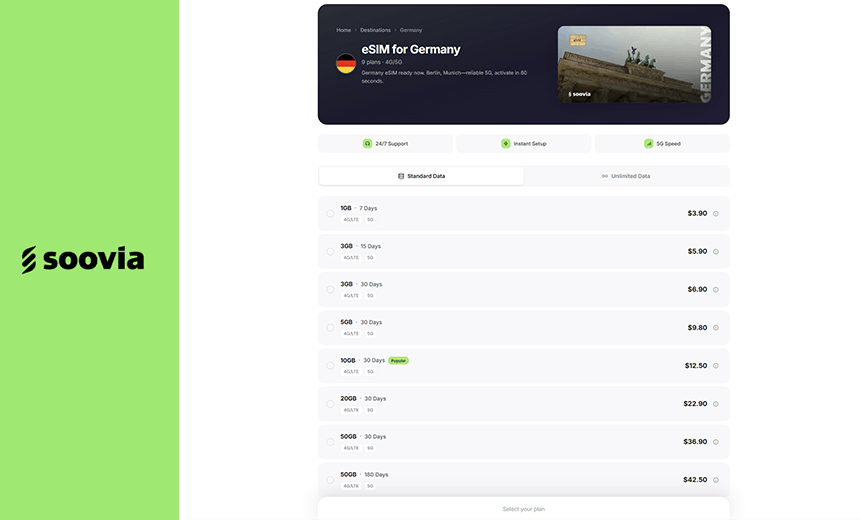
| Soovia | Best value, dual-network coverage | $3.90 | $9.80 | $12.50 | From $2.42/day | O2 + Vodafone |
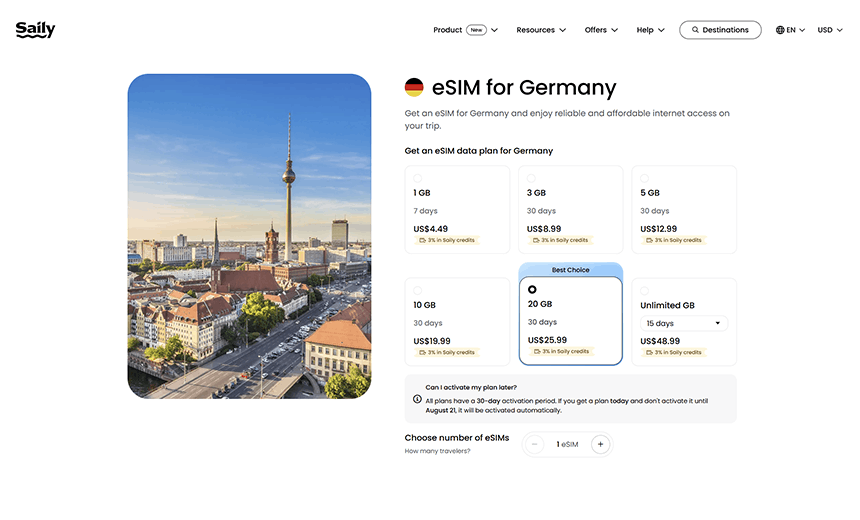
| Saily | Built-in security tools | $4.49 | $12.99 | $19.99 | From $48.99/10 days | Local partner networks |
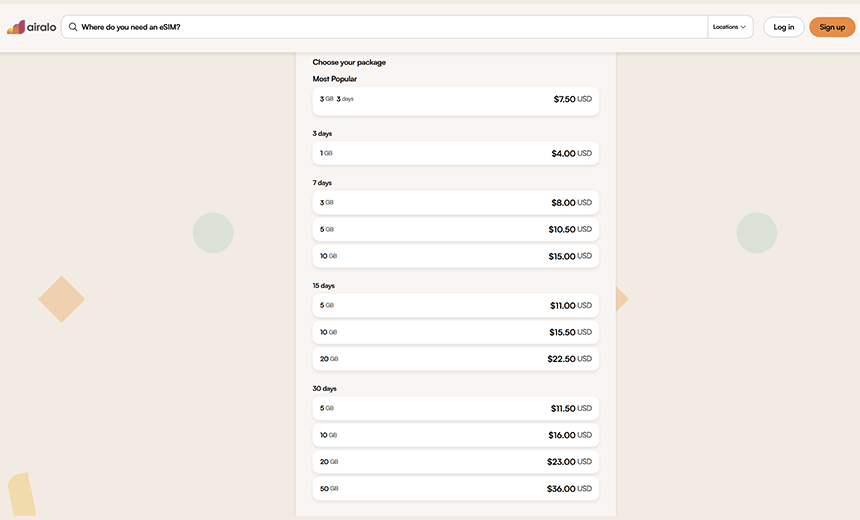
| Airalo | Biggest brand, most plans | $4.00 | $10.50 | $15.00 | From $11.00/3 days | O2 (Telefonica) |
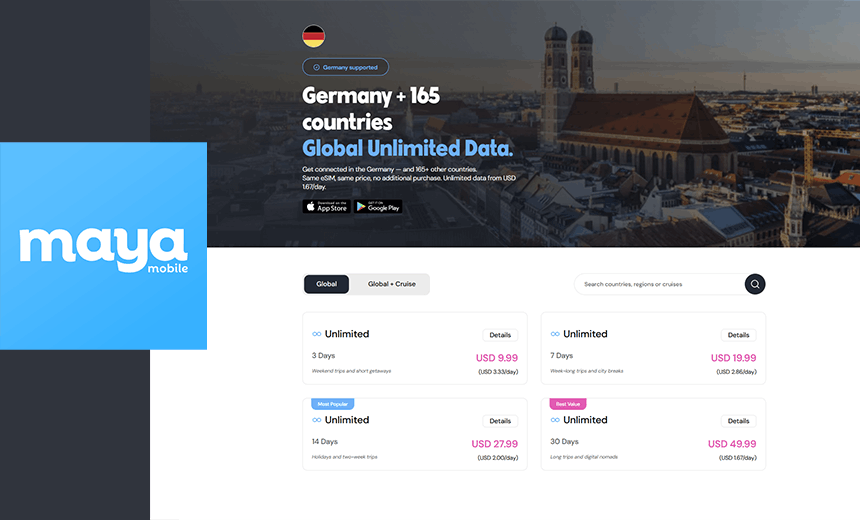
| Maya Mobile | Unlimited across borders | Not available | Not available | Not available | From $9.99/3 days | O2 |
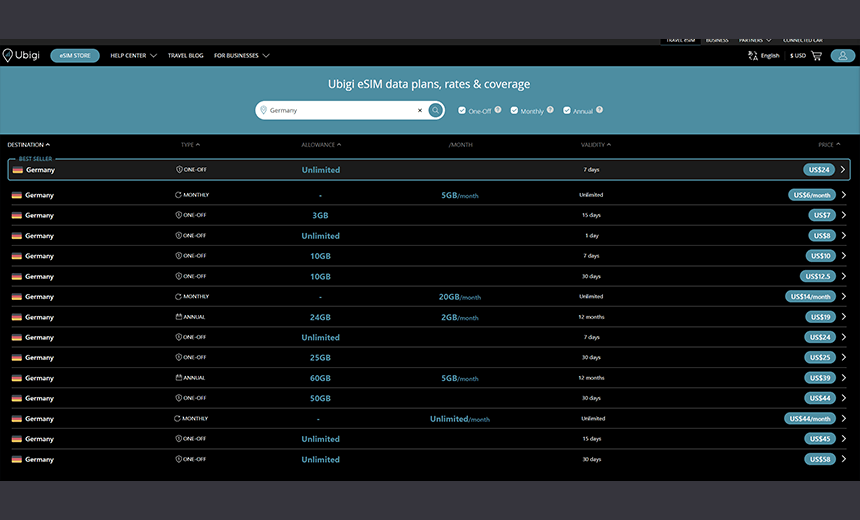
| Ubigi | Cheapest short-trip data | Not available | Not available | $12.50 | From $8.00/1 day | O2 (Telefonica) |
Prices and network details checked on each provider's own Germany page in July 2026. Carriers and plans change, so confirm before you buy.
One honest note before the reviews. Germany has three established nationwide networks most travelers are likely to use, Deutsche Telekom, Vodafone and O2, alongside the newer 1&1. Telekom still leads most major independent tests and generally has the strongest rural and 5G reach. None of the plans we verified for this comparison currently lists Telekom access.
In major cities, all three usually perform well enough that the differences are less noticeable for everyday use. Outside the cities, and along rail and road routes, access to a second supported network can make a meaningful difference. So check that the eSIM actually includes more than one German network before you buy, because partners vary by plan and can change.
1. Soovia: Two German Networks on One eSIM
2. Saily: The eSIM Built by the NordVPN Team
3. Airalo: From a 3-Day Layover to a 30-Day Stay
4. Maya Mobile: Buy Days, Not Gigabytes
5. Ubigi: Built for the Week-Long Trip
Check Your eSIM Compatibility Before You Buy
Two things decide whether an eSIM will work on your phone: the hardware, and whether the phone is carrier locked. Check both before you pay, not at the arrivals gate.
- Dial *#06# on your phone. If an EID number appears next to the IMEI, the hardware supports eSIM. No EID means no eSIM, whatever the spec sheet says.
- The safe list: iPhone XS and newer, Google Pixel 3 and newer, Samsung Galaxy S20 and newer. Region-specific models sometimes differ, so check rather than assume.
- Carrier lock is the real trap. A phone bought on contract in the US can support eSIM and still refuse a foreign profile.
- Unlock before you fly. Carriers can take several business days to process the request, and they will not rush it because your flight is tomorrow.
How to Install a Germany eSIM
Install it at home while you still have WiFi. The profile sits dormant until it reaches a German network, so nothing starts burning while you are still in your own country.
- Buy and scan. You get a QR code by email or in the provider's app. iPhone: Settings, Cellular, Add eSIM. Android: Settings, Network, Add carrier. If your phone puts things somewhere else, we have the full walkthrough for iPhone and for Android.
- Label it "Germany". Sounds trivial until you are toggling lines at 6am on four hours of sleep.
- Set the eSIM as your data line and leave the home SIM on for calls and texts.
- Turn off data roaming on your home line. This single setting is what prevents a surprise bill from your domestic carrier.
- Land, then enable roaming on the eSIM line only. It attaches within a minute or two. If it stalls, toggle airplane mode once.
A word on German trains, because they surprise people. ICE and IC services carry 4G along all major routes, but tunnels and cuttings still drop you to 3G or cut out briefly, and coverage is patchier than Swiss or French rail.
It is improving fast. Deutsche Bahn is laser-etching signal-permeable windows across roughly 70,000 panes and 3,000 coaches, replacing the old repeaters. Until that finishes, download your offline maps and tickets before you board.
Which Germany eSIM Should You Actually Buy?
There is no single winner here, only a right answer for your trip. This is how we would split it:
- Soovia if you want two networks instead of one and the lowest prices at almost every tier. 10GB for 30 days at $12.50.
- Saily if you want VPN and ad blocking bundled in, or if you actually need a German number for calls and SMS.
- Airalo if your trip is an awkward length. Nobody else covers 3, 7, 15 and 30 days this cleanly on capped plans.
- Maya Mobile if Germany is one stop on a longer European route and you would rather buy days than gigabytes.
- Ubigi if your trip is short and data-heavy. 10GB for a week costs $10.00, a third less than Airalo asks for the same tier.
Whichever you pick, buy it before departure. An arrivals hall on airport WiFi is the worst possible place to compare plans, and it is the exact moment your home carrier starts charging you.
What Travelers Want to Know About Germany eSIMs
Which is the best eSIM for Germany, and which one is right for me?
Soovia, for most travelers. It is the only eSIM here running on two German networks instead of one, and it is also the cheapest at almost every size. That pairing is rare, because a second network normally costs you more, not less. It loses in two specific places, and both are easy to check against your own trip. It has no German phone number, so if you need one, Saily is the only option on this list. And on a short, data-heavy week, Ubigi undercuts it at $10.00 for 10GB over 7 days.
How much data do I actually need for Germany?
Less than most people buy. For maps, messaging, email and the odd photo, 3GB covers a week comfortably. The number only climbs when video enters the picture, and that is what catches travelers out.
- Google Maps barely counts. Standard navigation runs 3MB to 5MB an hour, so a week of getting lost in Berlin hardly registers. Satellite view is the exception and can pass 100MB an hour.
- Social is where it goes. An hour of TikTok is close to 1GB. Instagram runs 600MB to 900MB.
- Video is the other drain. YouTube or Netflix at normal quality sits between 500MB and 1GB an hour. Video calls land at 200MB to 400MB.
Better than any estimate: check your own phone. On iPhone, Settings, Cellular lists usage per app. On Android, Settings, Network and Internet, Data usage. Take a normal month, divide by 30, then multiply by your trip length.
Then round up one size. Running out on day five and topping up in a panic costs more than buying the next tier before you fly.
Should I get a local SIM or a travel eSIM in Germany?
For most short trips, a travel eSIM is the easier option. Since 1 July 2017, German prepaid plans must be registered and identity-verified before activation, so a card bought at a kiosk or an airport will not work until that is done. Depending on the provider, verification happens online, in a carrier store, or through PostIdent at a Deutsche Post branch.
You will normally need a passport or another accepted ID, and you will be asked for an address, though this does not have to be a permanent German residential one. Online verification can take only a few minutes. In-person processing and final activation times vary by provider.
A local German plan is worth considering if you need a German phone number, local calls and texts, a larger long-term data allowance, or service running for several months. One thing worth clearing up: this is not a plastic-versus-digital decision. German carriers sell their local plans as eSIMs too. The real choice is a local plan against a travel plan, and for visitors who only need mobile data, the travel eSIM is usually faster and simpler to set up.
Is there a truly unlimited eSIM in Germany?
No. Every unlimited travel eSIM runs under a fair usage policy, and that includes all five here. Cross the daily threshold and your speed is reduced for the rest of that day.
The caps are usually generous enough for maps, messaging and normal browsing. If you stream in HD or tether a laptop all day, expect to meet them.
Any provider promising unlimited with no conditions is leaving something out. Read the fair usage terms before you buy, not after the speeds drop.
Can I make calls or send SMS in Germany with a travel eSIM?
Saily is the exception on this list. Add a minutes or text plan and you get a German number handling real incoming and outgoing calls plus standard SMS. The other four sell data only.
For most people data is enough. WhatsApp, FaceTime and Telegram all run over data, and your home SIM can stay active for calls as long as roaming stays off.
Watch your two-factor codes. If your bank sends them by SMS, keep the home line enabled for texts, or move to an authenticator app before you travel.